

What makes humans unique?
Tool use is a relative rare phenomenon in animals—less than 1% of the animal genera has been described to use tools- but it is taxonomically widespread. In fact, insects, marine invertebrates, fish, birds and mammals are the only taxonomic groups reported to use tools. The presence of this behaviour across different taxa has raised a question that remains unsolved to this day: do all these animal tool behaviours reflect intelligence or are they a reflection of specialised mechanisms?
Seeing an animal using a tool captures everybody’s attention—probably because it makes us question what marks humans out as truly unique. However, we currently lack a complete picture of whether and how tool use evolved in other animals, including invertebrates. The aim of this exciting project is to investigate tool use in an invertebrate species of bumblebee (Bombus terrestris). Bees display a sophisticated set of behaviours in a complex foraging context and, as such, provide an excellent study system to examine this behaviour in insects. This project will answer whether bumblebees understand that objects in the environment have properties and that can be used to achieve a goal. The findings will represent a step-change in tool use research, and, more generally, in human cognition research by exposing whether species which diverged from vertebrates over 550 million years ago are able of such a cognitive achievement.
This project is funded by The British Academy.

Tool use
In 1960 Jane Goodall made a discovery that changed forever the way researchers think of humans’ place within the animal kingdom. She observed a chimpanzee bent a twig, removed its leaves, and used it to “fish” termites from their nest. What Jane Goodall witnessed was that chimpanzees, like humans, use and make tools. These extraordinary findings forced us to reconsider the key cognitive differences between humans and other animals. Since then, we have learned that tool use is a relative rare phenomenon in animals—less than 1% of the animal genera has been described to use tools- but it is taxonomically widespread. In fact, insects, marine invertebrates, fish, birds and mammals are the only taxonomic groups reported to use tools. But do all these animal tool behaviours reflect intelligence or are they a reflection of specialised mechanisms? A simplified view of the different cognitive processes and mechanisms underlying tool use suggests that whereas in invertebrates (including insects) and fish this behaviour is stereotyped (i.e., behavioural specializations to solve particular problems), in birds and mammals tool use is rather flexible (i.e., individual learning of the behaviour through object exploration and manipulation to then recombine the information to produce solutions to new problems).
How are we going to test this?
We are going to be conducting lab studies with bumblebees. We will be developing a novel task that requires the use of an object to obtain a reward. At the moment, we are still developing the task, so stay tuned for updates on the progress!
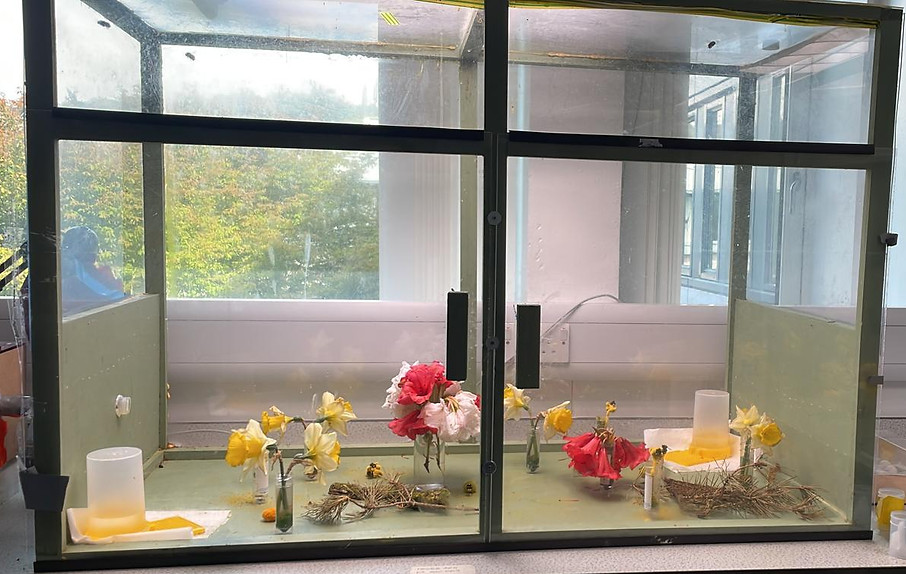
This is one of our flight boxes for the bees in our Bee lab
Gema Martin-Ordas
I am an Associate Professor at the University of Stirling (UK). As a researcher, I am interested in comparative cognition and the evolution of cognitive processes. I study different aspects of cognition (e.g., memory, reasoning, understanding of time) that can inform us about the evolution of cognition in both vertebrates (children, great apes, corvids) and invertebrates (bees). For this project, I will be focusing on investigating tool use abilities and the cognitive mechanisms underlying them in bumblebees.

Clara Lopez
My fascination for bees and my passion for science inspired me to pursue and successfully obtain a BSc (Hons) in Ecology at the University of Stirling. This degree developed my passion at a wider scale than previously imagined, leading me to graduate from the University of Glasgow with an MRes in Ecology and Environmental Biology. Through this incredible journey, I developed my master's thesis on the investigation of habitat preference and foraging behaviour in the Tree Bumblebee (Bombus hypnorum). More broadly, I am fascinated by the behavioural adaptation of bees and their extraordinary cognitive abilities, and I am thrilled to explore this more in detail as a research assistant for this project.
